Research & Scientific Centres in Uttarakhand
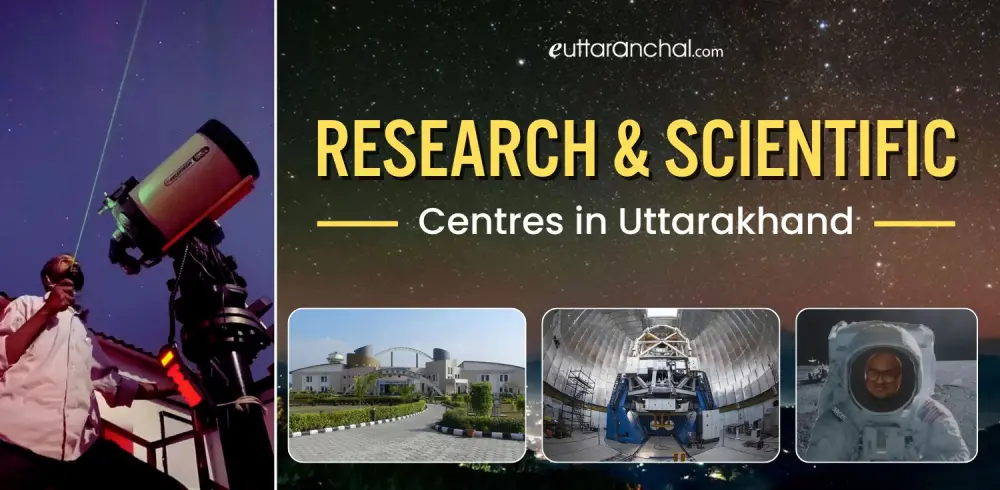
Uttarakhand is not only a land of spirituality and natural beauty but also an emerging hub for research, innovation, and scientific studies in India. The state hosts several prestigious institutes dedicated to fields like environmental science, forestry, astronomy, geology, and Himalayan studies.
These centers attract scholars, scientists, and students from across the country who contribute to research on climate change, biodiversity, disaster management, and sustainable development in the fragile Himalayan ecosystem.
Prominent institutions such as the Forest Research Institute in Dehradun, the Wadia Institute of Himalayan Geology, and the Aryabhatta Research Institute of Observational Sciences in Nainital play a vital role in advancing scientific knowledge related to forests, geology, and space sciences.
These institutes conduct pioneering research on Himalayan ecology, earthquakes, glaciers, and atmospheric sciences, making Uttarakhand a crucial center for mountain research in South Asia.
Apart from national institutes, reputed universities like Indian Institute of Technology Roorkee and Govind Ballabh Pant National Institute of Himalayan Environment also contribute significantly to scientific innovation and environmental conservation.
Many of these centers collaborate internationally and offer educational tours, training programs, and knowledge resources, making Uttarakhand an important destination for academic tourism and research-based exploration.
Get answers to questions about your travel plan. Here you'll find helpful information about activities, travel tips, safety guidelines, and seasonal recommendations.
Q: Which are the top research institutes in Uttarakhand?
A: Leading research institutes include the Forest Research Institute (FRI) Dehradun, Wadia Institute of Himalayan Geology, ARIES Nainital, IIT Roorkee, and GB Pant National Institute of Himalayan Environment.
Q: Why is Uttarakhand important for Himalayan and environmental research?
A: Uttarakhand’s location in the Himalayas makes it ideal for studying glaciers, earthquakes, landslides, biodiversity, and climate change, acting as a natural laboratory for mountain research.
Q: What research is conducted at the Forest Research Institute (FRI) in Dehradun?
A: FRI conducts research on forestry, biodiversity conservation, wildlife management, climate change, and sustainable forest development.
Q: What is ARIES Nainital known for?
A: ARIES Nainital is known for astronomy and astrophysics research, including the study of stars, planets, galaxies, and atmospheric science using advanced telescopes.
Q: Are there astronomy observatories in Uttarakhand?
A: Yes, observatories like ARIES Nainital and Starscapes Observatory offer stargazing sessions, astrophotography workshops, and educational programs.
Q: What is the role of the Wadia Institute of Himalayan Geology?
A: The institute researches earthquakes, tectonic movements, glaciers, and landslides to improve disaster preparedness and understanding of the Himalayas.
Q: How does IIT Roorkee contribute to scientific innovation?
A: IIT Roorkee contributes through research in earthquake engineering, water resources, renewable energy, artificial intelligence, and environmental science.
Q: What kind of environmental research happens in Uttarakhand?
A: Research focuses on climate change, glacier melting, forest conservation, biodiversity protection, and sustainable mountain development.
Q: Can students visit research centres in Uttarakhand?
A: Yes, many centres like FRI and ARIES allow educational tours, workshops, and training programs for students.
Q: Is Uttarakhand becoming a hub for scientific and academic tourism?
A: Yes, with its research institutes, observatories, and environmental centres, Uttarakhand is emerging as a destination for scientific tourism.
Q: Why is Uttarakhand suitable for disaster management research?
A: Due to its vulnerability to floods, landslides, and earthquakes, the state is important for studying early warning systems and risk reduction strategies in mountain regions.