Asan Barrage in Dehradun
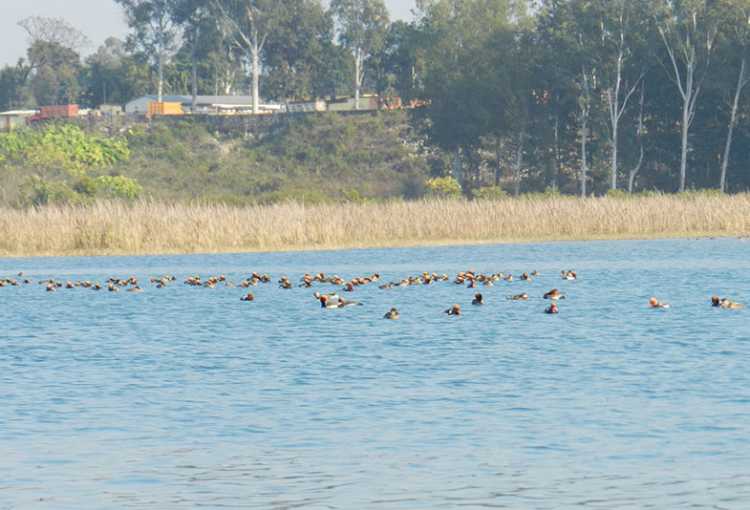
This is an ideal place for bird lovers, Ornithologists and Naturalists alike, who can travel easily up to the Asan barrage, and see thousands of birds who have travelled miles to be there. To watch a mallard or a red crested pochard, gently swimming a few hundred yards in wilderness is indeed an unforgettable sight.
Birds in Asan Barrage
Asan Barrage serves as a winter passage halt for trans-Himalayan migratory birds. These birds are spotted here on their way to southern India (October-November) and again on their way back (late February-March). By the end of October the Asan witnesses the arrival of migrants from Pale arctic region. The first to arrive is the shoveller followed by ruddy shelduck, mallard, coot, cormorant, egrets, wagtails, pond heron to name a few. Birds of prey like pallas fishing eagle, marsh harrier, greater spotted eagle, osprey and steppe eagle add to this magnificent diversity.
Birds: Greylag, Brahminy, C.Teal, Mallard, C. Pochard
Arrival: October
Departure: March/April
Birds: Gadwall, Wigeon, RC pochard, Tufted
Arrival: November
Departure: March/April
Birds: Pintail, Shoveller
Arrival: December
Departure: March/April
Asan Weather and Climate
Summers : max. 38C, min. 14C;
Winters : max. 21C, min. 2C;
Average Rainfall : 250 cm;
Monsoons: during June to September.
Best Time to Visit Asan Barrage
Winters might be the most exciting season for the bird lovers, but for the serious birdwatcher the other months of the year (early May to September end) offer just as exciting opportunities to see local migrants like painted stork, open billed stork, night heron. A flock of 25- 40 painted storks can be seen in these months every year.
Note: The barrage is also spelled as Assan Barrage or Aasan Barrage.
Location of Asan Barrage
Asan Barrage is located in near Dakpathar on Uttarkhand-Himachal border ( It is a small barrage situated at the confluence of Asan river and eastern Yamuna canal. It is situated on the northwest of Dehradun city near Uttarakhand-Himachal Border.).
Location & How to Reach Asan Barrage
Asan Barrage located at the confluence of River Yamuna and Asan near Dhalipur village is nearby. The Asan Reservoir is a small man-made wetland of ca. 4 sq km area, located 40 km west of Dehradun, in the west of Dehradun valley on Dehradun-Paonta road.
Air: The nearest airport is Jolly Grant, Dehradun, 72 km from Asan Barrage.
Road: Asan Barrage is connected to Dehradun, 38 km away by a highway, on the way to Paonta Sahib. Dehradun is well connected by rail, road and air.
Read How to Reach guide for Dehradun.
What is Asan Barrage famous for?
Asan Barrage is popular place for following activities/ interests - Bird Watching, Kids & family spots , Weekend Getaway, Wildlife Tourism.