Planning and arranging a mountain wedding is associated with both special opportunities and unique challenges. Issues such as altitude, logistics, seasonality, guest comfort, and local sourcing do influence these decisions. This guide focuses on food and catering at mountain weddings, particularly the destination weddings inUttarakhand.
When you finalize on a venue, the initial thought that comes to mind is how the catering service will run smoothly in the venue.What is an Indian wedding without good Indian delicacies? Remote sites usually have smaller access roads, it takes more time to bring supplies in, unreliable power or water, and other problems.
It implies that your caterer must have experience with basics such as mobile installation, clean and effective hot-holding systems, transport logistics for perishable goods, and backup for delays. The catering contract must clearly outline how the supplier will handle travel time for staff, equipment movement, the use of alternative fuel or generators, and whether menu items will rely on local supplies or need to be transported in.
One of the most important opportunities of a mountain wedding is to incorporate the scenery into the food. Think local: fresh or local produce, farm area, dairy, or herbs, or even local breads or flat breads. You may serve substantial comfort foods that are more suitable for colder conditions (such as warm soup, hot stew, and coarse breads) alongside lighter options. Meanwhile, since most of the guests may be from low-altitude or urban origins, consider the trade-off between local delicacies and well-known favourites.
During a mountain wedding, you get to make catering an experience for the guests. Live stands (such as a local dhaba-style stand, a home-brewed hot chocolate, or a wood-fired pizza stand) can be used in picturesque outdoor areas or in covered verandahs.
It can be seen that there are current trends in which interactive food stations and DIY bars are gaining popularity: food that is being cooked or made right in front of the guests feels theatrical and fresh. In the mountainous location, think about a rustic cooking booth - perhaps a live tandoor in a garden terracewith a view of a valley.
Catering must offer hearty and warm foods (soup, warm drinks, slow-cooked meals) and less solid drinks. Indian wedding catering has been in the news in recent times, with a great focus on all-inclusive menus (vegetarian, vegan, gluten-free, etc.). In the case of a mountain setting, you can add a wellness station where you will serve herbal teas, warm infused beverages, seasonal fruit compotes, and comfort snacks.
Eco-friendly practices are increasingly being integrated into destination weddings in natural locations, and food/catering are a significant component of that. The catering trend includes using local produce, seasonal food, various cuisines that reduce long-haul supply chains, compostable or reusable serving ware, donor-leftover-food programs, and minimizing the use of single-use plastics. In the case of a mountain wedding, it is particularly applicable: the locations can be in areas sensitive to the environment, local labor or transportation can be scarce, and waste disposal may be more challenging.
Decide with your caterer (and venue) to ensure the arrangement of how leftover food will be managed, and whether the menu design incorporates local producers or not.
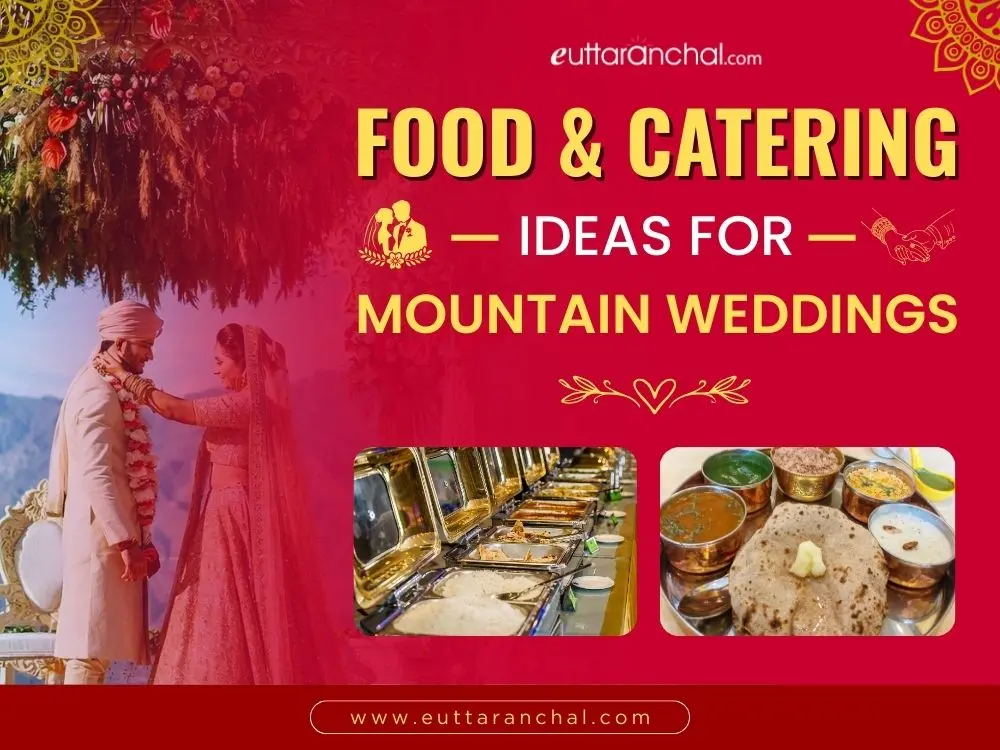
The menu for a wedding in Uttarakhand is to be a blend of local Pahadi cuisine, light fusion food, and crowd-pleasing dishes. You may begin with the basic local dishes such as Jhangora salad, Pahadi raita, Buransh (rhododendron) cooler, or Kumaoni aloo kegutke.
As the main meal, you could have some of the popular local dishes, such asKafuli (spinach curry), Phaanu (lentil curry), Gahat ki dal, Bhatt ki churkani, Mandua (ragi) roti, Bhaang ki chutney, and Jhangora ki khichdi. These may be stored alongside well-known dishes such as paneer, dal, rice, and grilled vegetables, so that no one feels out of place.
It is also possible to create a basic fusion dessert using other local ingredients, such as Jhangora kheer with a berry compote or bal mithai bites paired with vanilla ice cream.
These locations may also require more specific logistics to support catering, including equipment delivery, electricity supply, hot-holding capacity, breakdown/clean-up, and time coordination with daylight and guest transportation. Ensure that you confirm with your caterer whether they provide external generators for hot-holding, whether the kitchen has the capacity to handle a large number of guests, how waste will be disposed of, and whether the meal will be served through table service, buffet, or a hybrid style.
Weather conditions (sun, wind, rain) may be a factor to consider, which would necessitate a covered buffet in mountain settings, and staffing may need to be scheduled to accommodate earlier evening starts (when the sun sets earlier). Other aspects of ambient lighting include the dining areas, heated outdoor areas in case of a meal on the terrace, and the comfort of guests, such as warm drinks or blankets when necessary.
Make sure that the caterer is aware of the travel and venue-arrival schedule such that when the most part of the guests are available, the food should be still fresh.Welcome drinks should be served when the guests start to arrive and settle. The snacks should be timed to come in between. The main lunch or dinner service would have to begin earlier, and the breaks could be taken shorter.
In case of a multi-day mountain wedding, the different functions (welcome lunch, mehendi brunch, dinner, next-day brunch) allow the menu to be spread out and food to be interesting.
Destination weddings might involve additional budget line-item categories to cater to large weddings, such as transportation, equipment rental, additional staffing expenses, additional check-in/check-out time, and fuel/power contingency. While planning for catering you might have to pay a per-plate surcharge for delivery outside of the area or required minimum number of guests. Plan a good portion, waste disposal can be more difficult in mountain sites, to caterers and planners now wish to have service with minimum waste (such as plate controlled portioned meals or reduced buffet overflow area).
The latest industry trend focuses on the low-waste menus and the opportunity to offer food to the needy at events. Collaborate with your caterer to predict the number of guests, ensure that the numbers of plates are buffered, and service and breakdown time verified.
The season is a major factor when you are planning food arrangements in a mountain wedding in Uttarakhand. The weather may shift fast, either by adverse rain, heavy winds, or a decrease in temperature, so your catering needs to be mobile.
In winter or in colder seasons, food stands might require heating systems, covered tents, or tents in order to ensure food is kept warm and safe. Hot food, warm beverages, and live counters are emphasized to ensure that the guests remain comfortable.
The difficulty in summer is keeping food fresh. Dairy products, salads, and desserts require cooling facilities or insulated facilities due to the heat. Chilled counters, shaded areas, and early preparation are common in caterers to prevent wastage.
Monsoon has its own problems, sticky surfaces, moisture and time wastages. In this season, indoor or semi-covered restaurants would be more effective. They should preserve food counters in such a way that they cannot be affected by steam, moisture and insects.
Food and catering do not operate alone, you have to have a close liaison with the venue, transportation of guests, accommodation timetable and other suppliers (decoration, audio-visual, lighting).
As an example, you may have dinner after the ceremony and you would have to make sure that catering is taken to you after the guest transportation. When you have an outdoor terrace and want to have a weather cover, a lighting vendor, and a caterer who is going to provide service with power and hot-food.
Also remind guests of dressing suggestions (warm layer, comfortable shoes) in case they are dining out in the hills, and remember to add warm wraps, blankets or welcome-kits of hot drinks. The new trend focus on guest-comfort in destination weddings implies that the food experience should be in line with the physical environment requirements.
Prior to the day of the event, have a complete physical inspection with your catering crew: access to kitchen, delivery point of supplies, load-in, load-out points, flow of the guests, timing of menu, flow of hot-food, source of garbage, staffing, contingency of weather or transport delay. Dietary needs of the guests have been confirmed.
During the day, observe food service traffic and customer comments and post event with the caterer- what worked well, what could have been better with it being a mountain venue. Such feedbacks are used to ensure that better food logistics is integrated in future destination weddings.
Food and catering at a mountain wedding can have the power to make the experience of the guests memorable as long as the guest experience is taken care of at the place and the time of the function. If planned carefully, your mountain-wedding catering will be smooth, homey, and rooted to the location of your choice.