



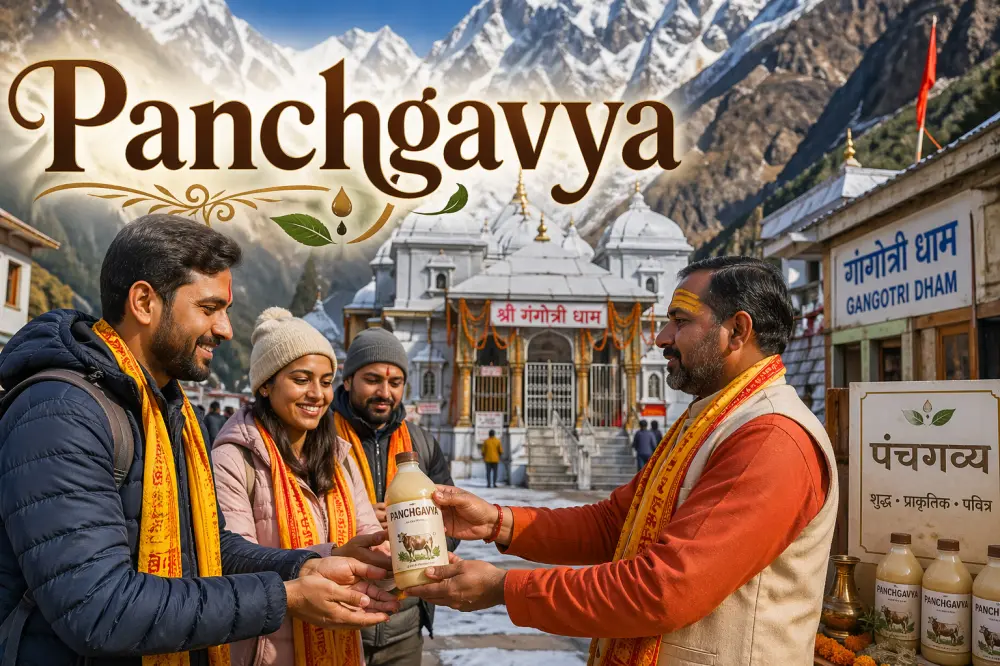
Panchgavya is a traditional preparation made from five products obtained from the indigenous cow. It has been used for centuries in Hindu religious practices, Ayurveda, and traditional agriculture. In recent times, Panchgavya has again come into public discussion following its mention during the Char Dham Yatra 2026.
This guide explains what Panchgavya is, its ingredients, religious importance, traditional uses, and why it continues to hold significance in Indian culture.
Panchgavya is a sacred preparation in Ayurveda and Hindu tradition made from five products derived from the cow — an animal revered in Indian culture as Gaumata, or the divine mother. The word itself breaks down simply: Panch means five, and Gavya means derived from the cow.
The five ingredients that make up Panchgavya are:
Each of these five ingredients has a specific role in traditional Hindu rituals. Depending on its purpose, Panchgavya may be prepared in different proportions for religious ceremonies, Ayurvedic formulations, or agricultural applications.
The Gangotri Temple Committee has announced that consumption of Panchgavya will be compulsory for non-Hindu pilgrims seeking entry into the temple, as a condition to confirm their adherence to Sanatan Dharma.
As the Char Dham Yatra in Uttarakhand gets underway, authorities have imposed restrictions on the entry of non-Hindus. Entry will only be permitted upon compliance with a set of specific religious conditions laid down by the temple committees.
Among the conditions, the Gangotri Temple Committee has passed a resolution stating that non-Hindu visitors will be allowed inside the temple premises only if they consume Panchgavya — a sacred mixture that includes cow urine, cow dung, milk, curd, and ghee. The committee has framed this requirement as a means of verifying a pilgrim's commitment to and respect for Sanatan Dharma before granting them access to the shrine. (as updated on 22 Apr 2026)
Panchgavya is not a new-age wellness trend — it has roots that go back over 3,000 years. References to it appear in some of India's oldest texts:
For millennia, Indian farmers, Ayurvedic physicians, and temple priests have used variations of this preparation across contexts ranging from healing fevers to purifying homes and nourishing crops.
Panchgavya is prepared by combining five cow-derived ingredients—milk, curd, ghee, gomutra (cow urine), and gomaya (cow dung). The preparation method varies according to its intended purpose, whether for religious rituals, Ayurvedic traditions, or natural farming. Temples and traditional practitioners generally prepare it according to their established customs.
Panchgavya is regarded as a sacred substance in Hindu traditions and is commonly used during temple rituals, purification ceremonies, yajnas, and various religious observances. In many traditions, it symbolises purification of the body and mind before participating in sacred rituals.
Classical Ayurvedic texts mention Panchgavya in certain traditional formulations. It has historically been associated with purification practices and is used only under the guidance of qualified Ayurvedic practitioners. Modern scientific evidence for many claimed health benefits remains limited, and it should not be considered a substitute for medical treatment.
In organic farming, Panchgavya is widely used as a natural plant growth promoter. Farmers use diluted preparations to improve soil microbial activity, support crop growth, and reduce dependence on chemical fertilisers as part of traditional natural farming practices.